Unlocking the Value of Organic Waste: Converting Waste into Sustainable Fuel
Dr. Abdul Rahim Nihmiya - Senior Lecturer, University of Sri Jayewardenepura
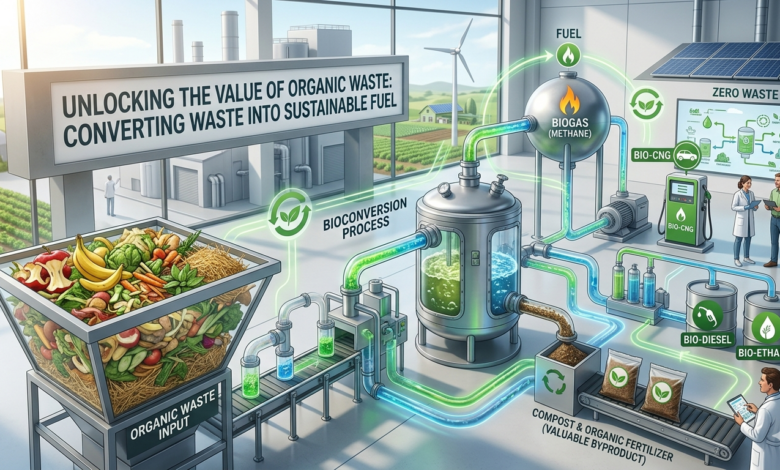
Sri Lanka generates large volumes of organic waste from multiple streams—households, markets, farms, livestock operations, food industries, and municipal services. Recent estimates put municipal solid waste (MSW) generation at ~7,000–8,800 tonnes per day. A key point is that Sri Lankan MSW is dominated by biodegradable material: around 62% is reported as biodegradable/organic. This means that ~4,300–5,500 tonnes per day of what we discard is potentially suitable for biological treatment.
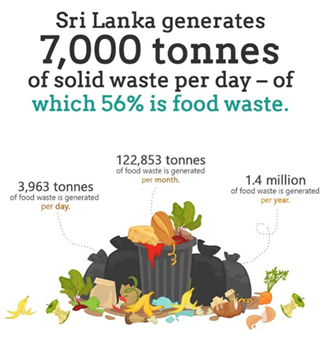
Source: The food and Agriculture Organization of the United Nations (FAO) and Ministry of environment, Sri Lanka
However, handling and disposing of this waste is both operationally and capital intensive for industries, municipal councils, and waste-management authorities—requiring collection fleets, labor, transfer stations, treatment sites, and environmentally safe final disposal. Collection itself is uneven: one country report by Institute for Global Environmental Strategies (IGES) notes that only ~37% of Sri Lanka’s city and district centers benefit from official MSW collection services, highlighting major gaps and leakage to open dumping and informal disposal routes. At the same time, agriculture supply chains and livestock activities generate substantial quantities of biodegradable waste, particularly from large wholesale vegetable markets and animal husbandry systems. In Sri Lanka, the Peliyagoda Central Wholesale Economic Centre, which handles thousands of tonnes of vegetables and fruits daily, produces significant volumes of organic waste due to sorting losses, spoilage, and post-harvest handling inefficiencies. In parallel, livestock farming contributes a continuous and reliable source of organic residues, primarily in the form of animal manure from cattle, poultry, and dairy farms. Official statistics from the Department of Census and Statistics indicate a substantial national livestock population, particularly cattle and buffalo, which collectively generate large quantities of manure on a daily basis. This manure is rich in organic matter and nutrients and has long been recognized as a proven biomass feedstock.
This environmental burden can be converted into an environmentally sustainable solution by processing segregated organic waste in anaerobic digesters to produce biogas—a clean fuel for cooking, heating, and electricity generation (via a biogas engine or microturbine). When used on-site (homes, farms, markets, canteens, food industries), biogas reduces LPG/firewood demand, cuts methane emissions from uncontrolled decomposition, and lowers disposal costs—shifting “waste management” toward resource recovery.
Converting waste into Biogas
Organic waste does not have to be thrown away. Instead, it can be converted into a clean and useful fuel called biogas. This conversion happens through a natural process known as anaerobic digestion. In simple words, anaerobic digestion means breaking down organic waste without oxygen. Tiny living organisms (microbes) digest the waste and produce biogas, which can be used for cooking, heating, and generating electricity.
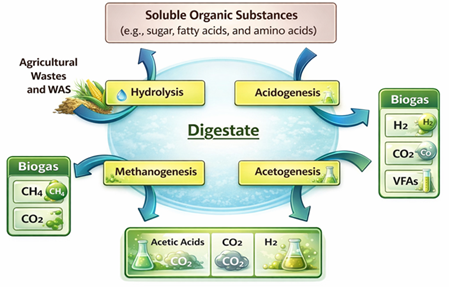
Biogas is produced in four simple stages, all happening inside a closed tank called a digester.
- Hydrolysis – Breaking waste into smaller pieces
This is the first step. In this stage, microbes start breaking large waste materials such as food scraps, plant matter, and animal waste into smaller and simpler substances like sugars, amino acids, and fatty acids. This step makes the waste easier for other microbes to digest.
- Acidogenesis – Making organic acids
In the second step, the small substances formed earlier are changed into organic acids and gases. This process is similar to fermentation. At this stage, the waste begins to release gases such as carbon dioxide and hydrogen, along with organic acids that are needed for the next step.
- Acetogenesis – Preparing for gas formation
In the third step, the organic acids are further converted into acetic acid, hydrogen, and carbon dioxide. This step is very important because acetic acid is one of the main materials needed to produce biogas.
- Methanogenesis – Producing biogas
This is the final and most important step. Special microorganisms convert acetic acid, hydrogen, and carbon dioxide into methane gas. Methane is the main component of biogas and is a and is a valuable, clean-burning fuel.
Benefits of Biogas Production in Sri Lanka
Biogas production offers Sri Lanka a practical and sustainable solution to address challenges related to energy security, waste management, public health, and environmental protection. With a large share of households still depending on firewood and biomass for cooking, biogas can play an important role in reducing pressure on natural resources.
Environmental Benefits:
In Sri Lanka, heavy reliance on firewood for cooking has contributed to forest degradation, soil erosion, and loss of biodiversity. In developing countries, fuelwood use is estimated to cause over half of deforestation, while deforestation contributes 17–25% of global greenhouse gas emissions. By replacing firewood with biogas, households can significantly reduce carbon emissions. Studies show that a single household biogas unit can save about 3 metric tons of firewood per year and reduce around 4.5 metric tons of CO₂ emissions annually. This makes biogas an effective tool for Sri Lanka’s climate-change mitigation efforts.
Health Benefits:
Many Sri Lankan households cook indoors using traditional stoves with poor ventilation. Smoke from firewood and dung releases harmful pollutants that cause respiratory diseases, asthma, pneumonia, and eye problems, especially among women and children. Biogas burns cleanly and produces almost no smoke, helping to reduce indoor air pollution and improve overall family health. Biogas programmes promote sanitation improvements by encouraging the proper collection and treatment of animal manure and organic waste in sealed digesters, rather than leaving them exposed in the environment. This controlled waste management reduces contamination of water sources by pathogens, thereby lowering the risk of water-borne diseases such as cholera and typhoid.
Social Benefits:
In rural Sri Lanka, women and children often spend hours collecting firewood, limiting time for education and income-generating activities. Biogas reduces this burden, improves safety, and enhances quality of life.
Agricultural and Energy Benefits:
Biogas systems also produce nutrient-rich slurry, which can be used as an organic fertilizer. This supports sustainable agriculture, reduces chemical fertilizer use, and improves soil health. Compared to composting or open dumping, biogas provides clean energy and lower emissions, making it a valuable solution for Sri Lanka’s transition to a greener future.
How to Build and Operate a Small-Scale Anaerobic Digester
You can turn your organic waste into a valuable clean fuel—biogas—by building and operating a small biogas digester at your home or premises. To get good results, it is important to understand a few basic factors that influence how much biogas is produced and how smoothly the system operates
- Choose the Right Waste (Feedstock):
What you put into the digester matters most.
✔ Nutrient balance
Organic waste should have a good mix of carbon and nitrogen.
- Vegetable waste, food waste, and crop residues provide carbon
- Animal manure provides nitrogen and helpful microorganisms
A good mix helps bacteria grow well and produce more gas. Too much protein waste (like poultry manure) can produce too much ammonia, which reduces gas production.
✔ Particle size
Chopping or crushing waste into small pieces helps bacteria digest it faster.
- Smaller pieces result in faster gas production
- But avoid grinding too fine, as it can cause blockages
2.Avoid Harmful Materials
Some substances can slow down or stop biogas production:
- Excess ammonia from poultry or protein-rich waste
- Oils and fats in large amounts
- Soap, detergents, chemicals, pesticides, or plastics
Tip: Never add cleaning chemicals or non-organic waste to the digester.
- Control the Process Conditions
✔ Temperature
Biogas bacteria work best in warm conditions.
- Ideal range: 25–40°C
- Keep the digester in a shaded but warm place
- Avoid sudden temperature changes
✔ pH (acidity level)
The digester should not be too acidic or too alkaline.
- Best pH range: 6.8–7.5
- Too much acid means less gas
Adding animal manure helps keep the pH balanced.
✔ Moisture content
Waste should be wet but not watery.
- Mix waste with water in a 1:1 ratio for wet digesters
- Very dry waste is hard to digest
- Too much water reduces gas quality
- Use a Good Starter (Inoculum)
To start biogas production faster, add a starter material:
- Fresh cow dung or digested slurry from another biogas plant
This helps useful bacteria grow quickly and reduces start-up time.
- Operate the Digester Properly
✔ Feeding rate
Add waste regularly and in small amounts. Overloading the digester can cause bad smell, foaming, and low gas output.
✔ Retention time
Waste needs enough time to produce gas.
- In warm climates: 20–30 days
- Do not remove slurry too quickly
✔ Mixing
Light mixing helps:
- Spread bacteria evenly
- Prevent solids from settling
- Improve gas production
Avoid strong or frequent mixing.
By following these simple guidelines, households and communities can successfully turn organic waste into useful energy.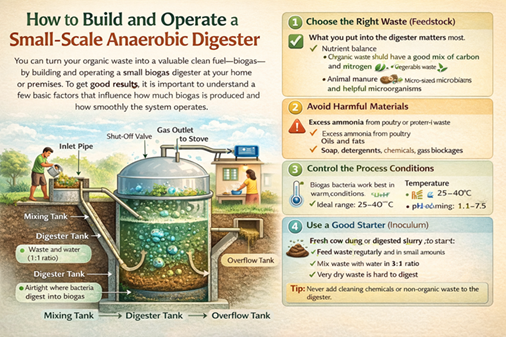
Acknowledgement
The figures were generated with the assistance of ChatGPT (ChatGPT AI, 2025).
References
- Bhatt and L. Tao, “Economic perspectives of biogas production via anaerobic digestion,” Bioengineering, vol. 7, no. 3, pp. 1–19, Sep. 2020, doi: 10.3390/bioengineering7030074.
- Parra-Ramírez, J. C. Solarte-Toro, and C. A. Cardona-Alzate, “Techno-Economic and Environmental Analysis of Biogas Production from Plantain Pseudostem Waste in Colombia,” Waste Biomass Valorization, vol. 11, no. 7, pp. 3161–3171, Jul. 2020, doi: 10.1007/s12649-019-00643-8.
- Collet et al., “Techno-economic and Life Cycle Assessment of methane production via biogas upgrading and power to gas technology,” Appl Energy, vol. 192, pp. 282–295, 2017, doi: 10.1016/j.apenergy.2016.08.181.
- Perera, H., et al., “Scaling multi-substrate biogas systems for national energy security and circular economy transition in Sri Lanka: A case study”. International Journal of Sustainable Management Research, 1 No. 3, 2025
- Samarasinghe, Keshan, and Priyantha DC Wijayatunga. “Techno-economic feasibility and environmental sustainability of waste-to-energy in a circular economy: Sri Lanka case study” Energy for Sustainable Development Vol 68, 308-317, 2022.

Dr. Abdul Rahim Nihmiya
Senior Lecturer
Department of Civil and Environmental Technology
University of Sri Jayewardenepura
Nugegoda, Sri Lanka