Near-Infrared (NIR) Technology: Shaping the Future of Soil Assessment and Sustainable Agriculture in Sri Lanka
Dr. Thulitha Sihalindu Ranwala, MBBS (Colombo) Postgraduate Registrar in Orthopaedic Surgery Entrepreneur & Researcher in Sustainable Agricultural Technologies
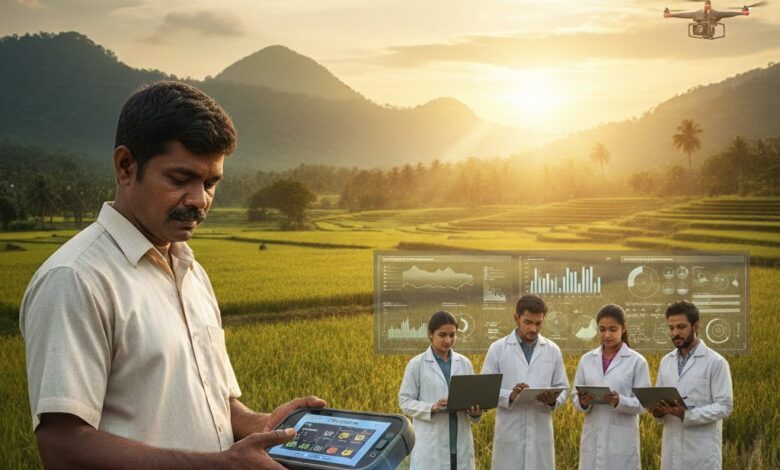
Soil is the foundation of agriculture, food security, and ecosystem resilience. In Sri Lanka—an agriculturally rich nation with diverse agro-climatic zones—maintaining soil health is increasingly critical in the face of climate change, rising input costs, and land degradation. However, conventional soil testing methods remain slow, laboratory-dependent, and inaccessible to many farmers.
Recent advances in Near-Infrared (NIR) spectroscopy have introduced a transformative approach to soil assessment and monitoring. This technology enables rapid, non-destructive, and cost-effective soil analysis, opening a new era of precision and data-driven agriculture.
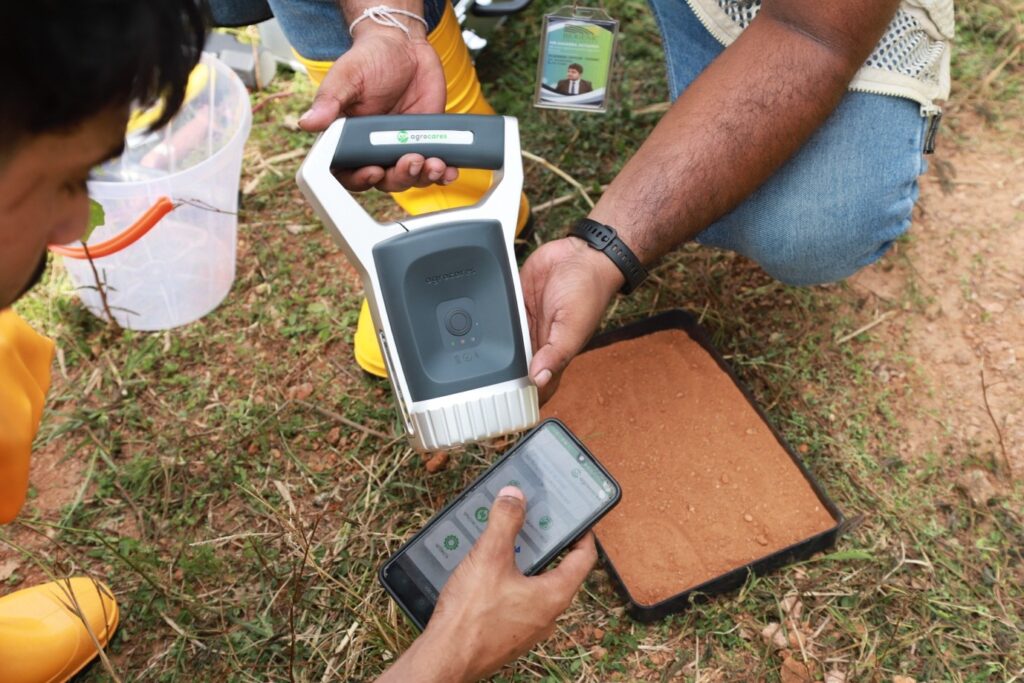
What Is NIR Technology in Soil Assessment?
Near-Infrared spectroscopy analyzes how soil reflects light in the near-infrared region of the electromagnetic spectrum. Organic matter, minerals, moisture, and nutrients interact with light in unique ways, allowing advanced algorithms to interpret soil properties from spectral signatures.
Modern portable NIR scanners can now estimate key soil parameters such as:
- Soil organic carbon and organic matter
- Total and available nutrients (N, P, K, Ca, Mg, etc.)
- Soil texture and moisture
- Cation exchange capacity and fertility indices
Unlike traditional chemical analysis, NIR-based soil testing can deliver results within minutes, directly in the field.
Recent Advancements in NIR Soil Technology
The latest generation of NIR soil scanners represents a major scientific advancement due to:
- Improved Calibration Models
Calibration using thousands of soil samples across agro-climatic zones has significantly increased accuracy and regional relevance.
- Cloud-Based Data Processing
Soil scans are now processed through global databases, allowing continuous learning, refinement, and benchmarking against international standards.
3. Integration with Mobile Platforms
Smartphone-based interfaces allow instant reporting, geolocation, and digital record-keeping.
- Soil Carbon Monitoring
Advanced models now enable estimation of soil organic carbon, a key indicator for climate mitigation, soil fertility, and regenerative agriculture.
These developments have shifted NIR technology from a research-level tool to a field-ready solution for farmers, extension officers, and policymakers.
The Future of Soil Monitoring
The future of soil monitoring will be continuous, digital, and predictive, rather than periodic and reactive. NIR technology will play a central role in this transition.
Key future directions include:
- Real-time soil health monitoring rather than seasonal testing
- Digital soil maps at field, district, and national levels
- Decision-support systems linking soil data with fertilizer, irrigation, and crop planning
- Verification of regenerative practices, including soil carbon sequestration
- Integration with climate models, early-warning systems, and sustainability reporting
Such systems will allow governments and institutions to move from generalized recommendations to site-specific, evidence-based agricultural policies.
Impact on Farmers
For farmers, especially smallholders, the impact of NIR-based soil assessment is profound:
- Reduced fertilizer costs through precise nutrient recommendations
- Improved yields by correcting hidden soil deficiencies
- Lower environmental damage from over-fertilization
- Greater resilience to droughts and climate variability
- Empowerment through knowledge, enabling informed decision-making
Most importantly, rapid soil diagnostics democratize access to science—bringing laboratory-grade insights directly to the field.
Relevance to Sri Lanka
Sri Lanka’s natural diversity—central highlands, monsoonal rainfall patterns, and varied soil groups—makes it ideally suited for precision soil intelligence. By adopting NIR-based monitoring at scale, Sri Lanka can:
- Strengthen national food security
- Reduce dependency on imported fertilizers
- Support climate-smart and regenerative agriculture
- Improve farmer livelihoods
- Align with global sustainability and soil-health initiatives
Conclusion
Near-Infrared soil technology represents a paradigm shift in how we understand, manage, and protect soil. As Sri Lanka moves toward sustainable development and climate resilience, embracing such scientific innovations is not optional—it is essential.
The future of agriculture lies in knowing the soil in real time, managing nutrients responsibly, and integrating science with farmer practice. NIR-based soil assessment is a key step toward that future.
References
- Kok, M., Sarjanta, S., Verweij, S., Vaessen, S. F. C., & Ros, G. H. (2023).
On-site soil analysis: A novel approach combining near-infrared (NIR) spectroscopy, remote sensing and deep learning.
Computers and Electronics in Agriculture, 205, 107603.
https://doi.org/10.1016/j.compag.2023.107603
Affiliations:
AgroCares, Nieuwe Kanaal 7, 6709 PA Wageningen, The Netherlands;
Nutriënten Management Instituut, Nieuwe Kanaal 7C, 6709 PA Wageningen, The Netherlands;
Wageningen University, Earth Systems and Global Change Group, PO Box 47, 6700 AA Wageningen, The Netherlands.
- van der Voort, T. S., Verweij, S., Fujita, Y., & Ros, G. H. (2023).
Enabling soil carbon farming: Presentation of a robust, affordable, and scalable method for soil carbon stock assessment.
Carbon Management, 14(1), 1–14.
https://doi.org/10.1080/17583004.2023.2163457
3. FAO. (2020).
Global Soil Laboratory Network (GLOSOLAN): Guidelines for soil laboratory harmonization. Food and Agriculture Organization of the United Nations, Rome.
4. Viscarra Rossel, R. A., et al. (2016).
Visible, near infrared, mid infrared or combined diffuse reflectance spectroscopy for simultaneous assessment of various soil properties.
Geoderma, 264, 287–299.

Dr. Thulitha Sihalindu Ranwala
MBBS (Colombo)
Postgraduate Registrar in Orthopaedic Surgery Entrepreneur & Researcher in Sustainable Agricultural Technologies