AstronomyMainSlideMust ReadNew FindingsResearch & InnovationTrending TopicsWhat's New
NASA’s New Space Telescope
August 29, 2026
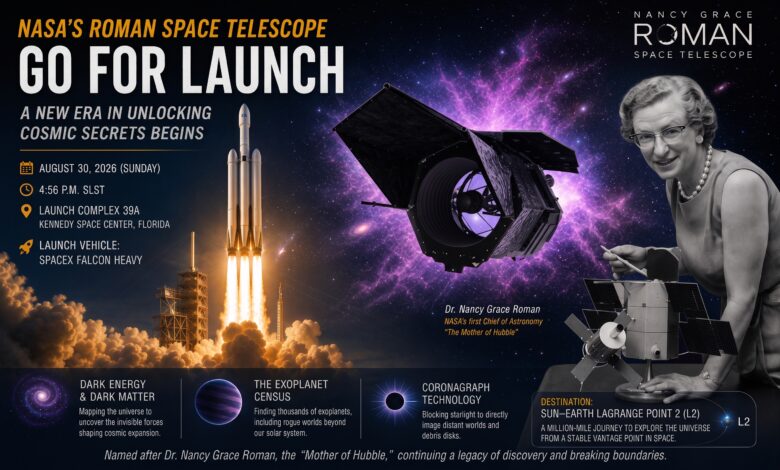
After years of meticulous development, assembly, and testing, the wait is finally over. NASA has officially cleared the Nancy Grace Roman Space Telescope for liftoff on Sunday, August 30, 2026, at precisely 4:56 p.m. Sri Lanka Standard Time (SLST). A SpaceX Falcon Heavy rocket will carry this next-generation infrared observatory into the sky from the historic Launch Complex 39A at Florida’s Kennedy Space Center.
Poised to alter our understanding of astrophysics fundamentally, the Roman Space Telescope is not just another eye in the sky. It is a panoramic lens designed to solve the greatest mysteries of modern astronomy – from the enigmatic forces of dark energy and dark matter to the hidden populations of exoplanets scattered across our galaxy.
A Panoramic View of the Universe
What sets the Roman Space Telescope apart from its predecessors is its extraordinary scope. While iconic observatories like Hubble and James Webb (JWST) have provided us with incredibly deep, high-resolution pinhole views of the cosmos, Roman is designed to look at the big picture.
Equipped with a 2.4-meter primary mirror-the same size as Hubble’s-Roman’s Wide Field Instrument will capture an area of the sky over 100 times larger than Hubble can in a single snapshot. Over its planned five-year mission, this sweeping infrared vision will enable astronomers to conduct statistical surveys on an unprecedented scale, mapping structures across the universe much faster than before. Planners estimate that Roman’s deep-field images will capture more than 2 billion galaxies over its lifetime.
Hunting in the Dark: Energy, Matter, and Exoplanets
Roman’s scientific payload is built to tackle specific, monumental questions:
-
Dark Energy and Dark Matter: Roughly 95% of our universe is made up of dark matter (which holds galaxies together) and dark energy (which is driving the accelerated expansion of the universe). By surveying the distribution of galaxies over cosmic time and tracking thousands of distant supernovae, Roman will measure the effects of these invisible forces with unprecedented precision.
-
The Exoplanet Census: Using a technique called “gravitational microlensing,” Roman will monitor hundreds of millions of stars near the center of the Milky Way. When a star with a planetary system passes in front of a more distant background star, the foreground system’s gravity bends and magnifies the background star’s light. This will allow Roman to discover thousands of new exoplanets, particularly rogue planets floating freely without a host star, and planets orbiting far from their suns.
-
Coronagraph Technology: The observatory also features an advanced Coronagraph Instrument, a technology demonstrator that will block the blinding glare of host stars to directly image large, Jupiter-like planets and debris disks orbiting them.
The Journey to Lagrange Point 2
This launch represents a highly coordinated feat of orbital physics. Because the launch window is instantaneous, the Falcon Heavy must lift off at the exact scheduled second. Should weather or technical holds scrub the attempt, a backup window opens on Monday, August 31, at 4:52 p.m. SLST. Weather forecasts for Sunday morning currently lean favorable, though teams are monitoring a small chance of showers.
Following separation from the Falcon Heavy launch vehicle, Roman will embark on a million-mile journey to the second Sun-Earth Lagrange point (L2). At this gravitationally stable vantage point-which it will share with the James Webb Space Telescope-Roman will deploy its solar arrays and begin a months-long commissioning phase to cool its instruments and calibrate its optics.
Named after Dr. Nancy Grace Roman, NASA’s first Chief of Astronomy and the woman affectionately known as the “Mother of Hubble,” this telescope carries a legacy of breaking boundaries. As scientists around the globe prepare their data pipelines for the flood of information to come, one thing is certain: this launch is just the beginning of a magnificent new chapter in cosmic discovery.
Resources:
-
Space.com: Nancy Grace Roman Telescope live updates
-
For more context on the mission, you can check out this playlist detailing the capabilities of the Roman Space Telescope.