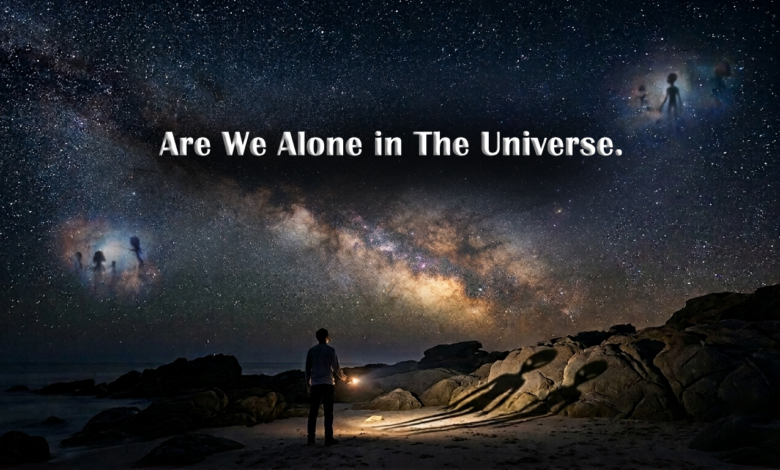
Have you ever looked up at the night sky and wondered, “Is there anyone else in this vast expanse of sky looking at us?” The planet we live on is like a tiny grain of sand in an enormous cosmic ocean. If so, are we the only ones living in this vast universe?
The Probability of an Infinite Universe
According to scientists our universe is about 13.8 billion years old. It is estimated that there are about 2 trillion galaxies. In our Milky Way alone, there may be about 40 billion planets like Earth with temperatures suitable for supporting life (Habitable Zone). Looking at such enormous numbers, it is almost impossible to think that life exists only on Earth.
What is Extraterrestrial Life?
Any life that originated outside of Earth is called ‘extraterrestrial life’. There may be several:
- Microorganisms: Simple organisms like bacteria that are invisible to the naked eye.
- Strange Creatures: Animals with bodies that we are not familiar with.
- Intelligent Beings: Civilizations far more technologically advanced than ours.
The science of studying about this phenomenon is called Astrobiology.
What could aliens look like?
There are various assumptions about the appearance of aliens. According to living beings inhabiting the Earth, creatures who are able to move should have a front and a back with organs such as eyes positioned in the front. Some say they are, Humanoids: creatures that look similar to humans, or Greys: usually grey-skinned creatures with short bodies, and large heads, or Nordics: white, tall-looking creatures. But sometimes they could even be creatures floating in the air, without a permanent shape. Their appearance is determined by the gravity and environment of the planet on which they live (Figure 1).

(Figure 1)
Drake Equation
A Scientist named Frank Drake devised a mathematical equation to find out how many advanced civilizations there might be in our galaxy with which we could communicate (Equation 1).

(Equation 1)
Each letter denotes as follows :
- N (Number of Civilizations): The number of intelligent civilizations within our Milky Way that we can connect with.
- *R (Rate of Star Formation) The average rate (speed) at which new stars are formed in our galaxy per year.
- fp (Fraction of Stars with Planets): Among those stars the percentage of stars having a planetary system (not every star has planets).
- ne (Number of Habitable Planets): The average number of planets with temperatures and environments suitable for life among stars that have planets.
- fl (Fraction Where Life Develops): Among planets with a suitable environment for life, the percentage of planets that actually develop life.
- fi (Fraction with Intelligent Life): The percentage of life-bearing planets where intelligent life develops (such as humans).
- fc (Fraction with Communicative Technology): The percentage of those intelligent beings that develop technology that can dispatch things like radio signals into space.
- L (Length of Civilization): The length of time that such an advanced civilization remains without collapsing and continues to dispatch signals into space.
When all these values are multiplied together, we can get a rough idea of the number of alien civilizations in the galaxy. According to scientists, this number should be at least 20.
Kardashev Scale
A civilization’s advancement can be classified according to the amount of energy they consume:

(Figure2)
- Type I: Civilizations that can control all the energy on their planet.
- Type II: Civilizations that can draw on the full energy of their sun (e.g., through structures like the Dyson Sphere – (Figure 2) a conceptual structure that can be built by assembling a large number of solar panels around a star.)
- Type III:
Highly advanced civilizations that can control the energy of the entire galaxy.
Humans are still at level 0.73. That is, we have not yet reached the first type. The humans do not yet have the ability to use the full amount of energy that the Earth receives and already has.
Fermi Paradox
If the universe is so vast and life must exist, why haven’t they contacted us yet? This is called the Fermi paradox. There could be several reasons for this:
- We are truly alone.
- Civilizations collapse without lasting long.
- Even though they exist, we are unable to identify them.
- Zoo Hypothesis: Even though they are observing us, they remain secretive, without interfering with our natural evolution.
Mysterious evidence and clues
Over the years, some dubious facts about extraterrestrial life have been found:
- UFO (Unidentified Flying Objects):
- Wow! Signal (1977): A very powerful radio signal of 72 seconds’ duration received from space. This is still a mystery.
- Europa: It is believed that bacteria-like organisms may exist beneath the icy layer of this moon of Jupiter.
- Tabby’s Star: A star that is strangely diminishing. Perhaps the reason for this is a giant structure built by advanced creatures.
- Boötes Void: A vast empty space in the universe. Some believe that this could be an area where an advanced civilization has built a Dyson sphere around stars. (An enormous “empty space” with fewer galaxies in the universe, it is a natural part of the cosmic structure.)
Projects searching for extraterrestrial life
Scientists have been searching for extraterrestrial life with perseverance:
- SETI (Search for Extraterrestrial Intelligence): Examines radio signals coming from space.
- Galileo Project: Conducts scientific studies on extraterrestrial technologies and UFOs.
- SERENDIP Project (Search for Extraterrestrial Radio Emissions from Nearby Developed Intelligent Populations): Analyses data coming from deep space. Up to now, about 400 suspicious signals have been detected.
Conclusion
It is still uncertain whether or not aliens exist. The universe is huge and mysterious. One day, we will get an answer to this question. Until then, remember this when you look up at the night sky… Maybe someone else is watching you from somewhere in the universe!
” The best evidence to support that intelligent beings exist elsewhere in the universe is that they have not tried to reach out to us yet.” – Bill Watterson
References
- Drake, F. (1961). The Drake equation.
- Dyson, F. J. (1960). Search for artificial stellar sources of infrared radiation. Science, 131(3414), 1667–1668.
- Fermi, E. (1950). The Fermi paradox.
- Kardashev, N. S. (1964). Transmission of information by extraterrestrial civilizations. Soviet Astronomy, 8, 217–221.
- National Aeronautics and Space Administration. (n.d.). Astrobiology: The study of life in the universe. Retrieved from https://astrobiology.nasa.gov
- National Aeronautics and Space Administration. (n.d.). Europa: Jupiter’s ocean world. Retrieved from https://www.nasa.gov
- Ohio State University Radio Observatory. (1977). The “Wow!” signal.
- Planetary Society. (n.d.). Search for extraterrestrial intelligence (SETI). Retrieved from https://www.planetary.org
- SETI Institute. (n.d.). Search for extraterrestrial intelligence. Retrieved from https://www.seti.org
- University of California, Berkeley. (n.d.). SERENDIP project.
- Harvard University. (n.d.). The Galileo project.
- Boyajian, T. S., et al. (2016). Planet hunters IX: KIC 8462852 – Where’s the flux? Monthly Notices of the Royal Astronomical Society, 457(4), 3988–4004.
- Kirshner, R. P., Oemler, A., Schechter, P. L., & Shectman, S. A. (1981). A million cubic megaparsec void in Boötes. The Astrophysical Journal, 248, L57–L60.
- Image 1 – https://www.twinkl.co.uk/resource/t-n-4178-2d-shape-aliens-display-cut-outs
- Image 2 – https://www.salon.com/2024/07/06/astronomers-spot-seven-stars-that-may-sport-alien-megastructures-but-many-are-skeptical-of-aliens/

Sasada Senevirathna,
Assistant Director,
Research Division,
Ministry of Science and Technology.