AstronomyEditor's PicksMainSlideMust ReadNew FindingsScience InsiderTrending TopicsWhat's New
Record-Breaking Star Unlocks Secrets of Our Galaxy’s Supermassive Black Hole
Deep in the center of our Milky Way galaxy lies a supermassive black hole known as Sagittarius A*. For decades, astronomers have watched stars swirl around this invisible giant. But a newly discovered star has just shattered all the records – and it might be the key to proving one of Albert Einstein’s most mind-bending predictions.
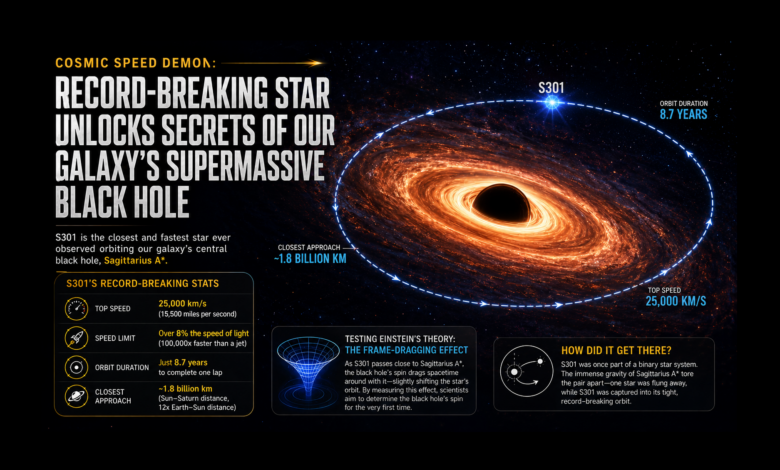
The star, named S301, is the closest and fastest star ever observed orbiting our galaxy’s central black hole.
Blistering Speeds and a Dangerously Close Orbit
Finding S301 was no easy task. The star is incredibly faint – about two billion times dimmer than the bright stars we see in our night sky. An international team of scientists used the ultra-powerful Very Large Telescope Interferometer (VLTI) and its upgraded GRAVITY+ instrument in Chile to trace its extreme path.
When S301 makes its closest approach to the black hole, the enormous gravitational pull slingshots the star to speeds that are hard to comprehend:
| Feature | S301’s Record-Breaking Stats |
| Top Speed | 25,000 kilometers per second (15,500 miles per second) |
| Speed Limit | Over 8% the speed of light (100,000 times faster than a commercial jet) |
| Orbit Duration | Just 8.7 years to complete one lap around the black hole |
| Closest Approach | Roughly 1.8 billion kilometers (about the distance from our Sun to Saturn, or 12 times the distance of Earth to the Sun) |
Despite swooping so close, S301 is moving entirely too fast to be sucked in. Instead, it uses its immense momentum to escape the black hole’s grasp and fly back out on a highly stretched, oval-shaped orbit.
“What is special about this star is that it’s orbiting Sagittarius A* on a very tight orbit… That is unprecedented,” explained Felix Mang, a researcher at the Max Planck Institute for Extraterrestrial Physics.
Testing Einstein’s Theory: The “Frame-Dragging” Effect
The real excitement surrounding S301 isn’t just its speed – it’s what that speed allows scientists to measure.
Astronomers know that Sagittarius A* has a mass equal to about 4.3 million Suns. Like most objects in the universe, scientists believe this massive black hole is spinning.
According to Albert Einstein’s general theory of relativity, a spinning black hole is so dense and powerful that it literally drags the fabric of space and time around with it, like a spoon swirling in a cup of thick honey. This phenomenon is known as frame-dragging.
Because S301 travels so close to the black hole, this twisted “honey” of spacetime should slowly change the direction of the star’s orbit over time.
“S301 is the first star to orbit directly in the region around Sagittarius A* where the frame-dragging effect is extreme,” noted Mang. “We’re not just measuring spacetime curvature; we are measuring how it gets distorted by the rotation of the black hole itself. That is unique”.
By carefully watching S301 over the next decade, astronomers hope to directly measure the spin of our galaxy’s supermassive black hole for the very first time.
How Did It Get There?
Stars cannot naturally form that close to a supermassive black hole—the gravitational forces are simply too chaotic.
Astronomers suspect that S301 was originally part of a “binary pair”—two stars orbiting each other. Eons ago, the pair likely wandered too close to Sagittarius A*. The black hole’s extreme gravity ripped the partnership apart, violently kicking one star completely out of the area while capturing S301 in its current, tightly bound orbit.
Reference Sources
-
European Southern Observatory (ESO): Milky Way’s fastest star orbits our supermassive black hole so closely it feels its spin
-
Max Planck Institute for Extraterrestrial Physics: A star that feels our Galaxies central black hole rotate
-
The Times of India: Scientists found the world’s fastest star moving at 15,500 miles per second